J J Hilder
Painted Coogee - Shaped Australian Watercolour
Jesse Jewhurst Hilder (1881-1916) was an Australian watercolourist born in Toowoomba, Queensland. He showed early talent in drawing, studied on scholarship at Brisbane Grammar School, and later
worked for the Bank of New South Wales. His artistic development accelerated after meeting Fred Leist and Julian Ashton, who encouraged him to pursue painting seriously.
Hilder suffered from tuberculosis for most of his adult life, forcing him to move frequently in search of a dry climate, yet he continued to paint with remarkable productivity.
When studying at Julian Ashton's art classes in Sydney around 1904-1905, he used the fake name "Joyce". During this time, he also signed a number of his early paintings with the nom de plume "Anthony Hood".
He did this primarily out of fear that his employer, the Bank of New South Wales, would disapprove of his artistic pursuits. Once his reputation grew and he eventually resigned
from the bank due to failing health, he painted under his real name.
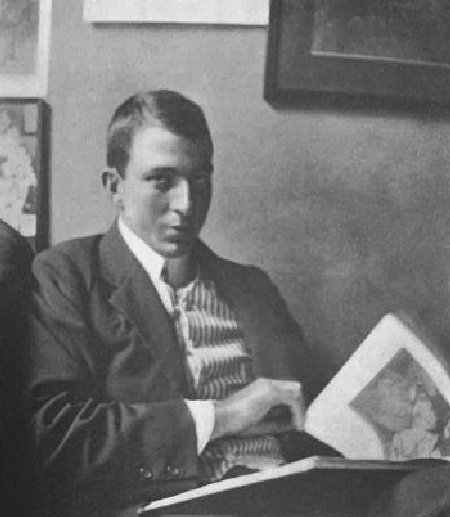
Jesse Jewhurst (J.J.) Hilder
Meets Frederick Leist
When J. J. Hilder arrived at the Waverley branch of the Bank of New South Wales in 1904, he stepped - almost accidentally - into the artistic world that would transform his life. It was here that he met
the painter Fred Leist, who immediately recognised the young bank clerk's quiet talent. Leist urged him to take his watercolours to Julian Ashton, setting in motion the chain of encouragement that
shaped Hilder's brief but brilliant career. From Waverley, Hilder wandered the eastern suburbs with his sketchbook, capturing the soft coastal light in works that would later define him as one of Australia's
most lyrical watercolourists. (You can read more about Frederick Leist and his family here.
Eastern Suburbs Art
Hilder painted widely around Sydney, including coastal subjects such as Coogee, though his Coogee works are less famous than those by Streeton or Conder. His Sydney period
(from 1904 onward) included regular sketching trips to the eastern suburbs, and his watercolours from this time show the soft, atmospheric handling of light that became his hallmark,
Hilder's Sydney landscapes from this period share the same qualities: muted colour, gentle tonal transitions, and a lyrical calm. This is consistent with his broader style and the reception of his early
Sydney watercolours. His first major exhibition in 1907 caused a sensation, and Arthur Streeton hailed him as a genius.
Coogee Painting
J.J. Hilder's Coogee (1907) is held in the collection of the Art Gallery of New South Wales. It is a delicate, intimate watercolor that showcases his signature romantic tonalism and lyricism.
Painted from a high vantage point overlooking Coogee Bay, the scene features a grassy foreground and dense, soft washes of foliage that frame a distant view of the sapphire ocean and surrounding headlands.
Warm ochres, terracottas, and soft greens in the foreground contrast gently with the blues of the Pacific Ocean and sky, capturing the haze and ambient light of coastal Sydney.
Hilder uses gentle brushwork and subtle tonal transitions to strip away the harshness of midday sunlight, giving the coastal landscape a quiet, dreamlike atmosphere rather than a strictly topographical record.
Personal Life
He married Phyllis Meadmore In Sydney on 28 April 1909. Encouraged by her, and with savings from his salary from the bank and some art sales, he began life as a full-time professional artist. They had two
sons. They first moved to a house at Lawson in the Blue Mountains, and from then on their life involved moving from one location to another in search of dry climate conditions that would aid his failing health.
One son, Vernon Arthur ("Bim") Hilder (1909-1990) became a noted artist and sculptor in his own right. Generations of the Hilder family have continued to make their mark on the artistic life of
New South Wales since. He did aged just 34 at Hornsby (NSW) in 1916.
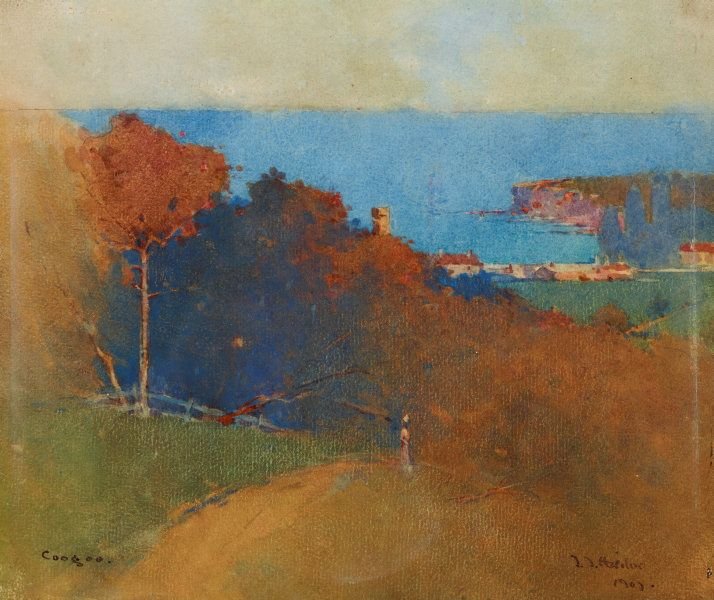
Coogee by J. J. Hilder, 1907 - collection of the Art Gallery of New South Wales
His Influence on Art and Watercolours
Hilder's influence on Australian art, especially watercolour, -as significant and lasting. He was regarded as Australia's most brilliant watercolourist of his generation. Julian Ashton described him as
"the most brilliant and romantic water colourist Australia has so far produced." He transformed Australian watercolour by introducing a distinctive combination of broad, simplified forms and
tender atmospheric colour harmonies.
Although he died young, his reputation was cemented by posthumous publications and exhibitions, including The Art of J. J. Hilder (1918), which helped establish him
as a central figure in Australian landscape painting.
Legacy
J. J. Hilder was a gifted, sensitive watercolourist whose short life produced some of the most admired landscape watercolours in Australian art. His Sydney works, including Coogee,
show his mastery of atmosphere and tonal subtlety. His influence on watercolour technique, composition, and expressive landscape painting was profound, and his legacy endures through both his art
and the artists he inspired.
References
Hilder, Jesse Jewhurs(1881 -1916) Dictionary of Australian Biography Sydney: Angus & Robertson, 1940 (G. Searle, ed.) (retrieve 15 Sept 2026) (https://gutenberg.net.au/ebooks15/1500721h/0-dict-biogHi-Hu.html)
'Death of J. J. Hilder', The Sydney Morning Herald, Wed 12 Apr 1916 , Page 11
Bernard Smith, 'Hilder, Jesse Jewhurst (1881-1916)', Australian Dictionary of Biography, National Centre of Biography, ANU, (https://adb.anu.edu.au/biography/hilder-jesse-jewhurst-6666/text11493),
published first in hardcopy 1983, accessed online 16 September 2026.
|